Tai Chi Walking for Beginners: 5 Steps, Step by Step
Tai Chi walking is a slow walk where you place the heel down first with no weight on it, then shift your weight onto that foot gradually. This guide teaches the basic step in five parts, gives you a 5-minute routine you can do indoors, and lists the mistakes most beginners make.
If you would rather follow along on video, Tai Chi Beginners & Seniors, the app we make, has a Tai Chi Walking program with step-by-step video. Download it on the App Store. Free download with in-app purchases.
What is Tai Chi walking?
Tai Chi walking is the footwork of Tai Chi practiced on its own. In a normal walk you fall forward onto each foot. In Tai Chi walking you stay balanced over one leg, place the other foot, and only then move your weight across.
Harvard Health, in an article reviewed by Tai Chi instructor Stanwood Chang, describes it as the stepping part of Tai Chi forms. You can practice it without learning a whole form.
Before you start
- Clear a path. You need about 6 to 10 feet (2 to 3 metres) of flat floor. A hallway works well.
- Stay near support. Walk beside a wall, a kitchen counter or the back of a sofa so you can touch it if you wobble.
- Wear flat shoes or go barefoot on a floor that is not slippery. Avoid socks on smooth floors.
- Go slowly. Slow is the exercise. There is no prize for covering distance.
If you have balance problems, dizziness, joint pain or a recent injury or surgery, ask your doctor or physiotherapist before you try this.
Tai Chi walking step by step
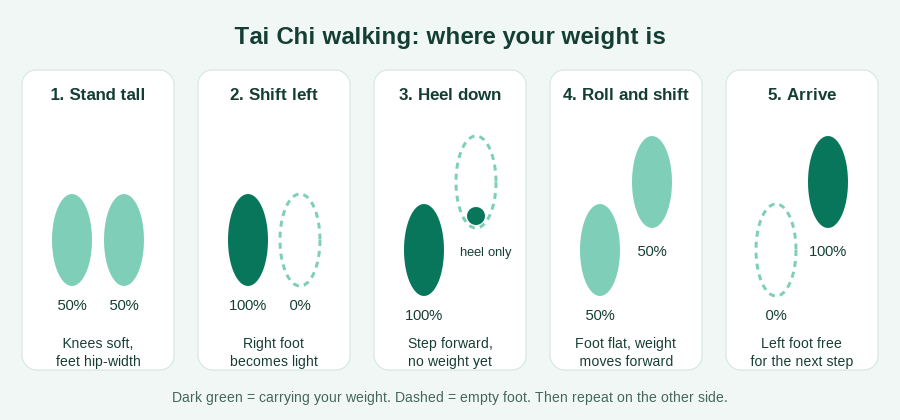
Step 1. Stand tall with soft knees
Stand with your feet about hip-width apart. Let your arms hang by your sides or rest your hands on your hips. Bend your knees a little, as if you were about to sit on a high stool. Keep your head up and your shoulders relaxed.
Step 2. Shift your weight onto one leg
Slowly move your weight onto your left leg until your right foot feels light. Your right foot should be able to lift without your body tipping. If you cannot lift it without leaning, shift a little further.
Step 3. Place your heel down with no weight on it
Step forward with your right foot and touch the heel to the floor. Keep the step short, about the length of your own foot. All your weight is still on the back leg. You should be able to lift the front foot again without moving your body.
Step 4. Roll the foot flat and shift forward
Lower the rest of your right foot to the floor. Then move your weight forward slowly until it is over your right leg. Keep both knees soft. Your front knee should stay above your foot and not push past your toes.
Step 5. Bring the back foot through
When your weight is fully on the right leg, lift your left foot and bring it forward. Touch the heel down, with no weight, to begin the next step. Now repeat steps 3 to 5 on the other side.
That is one Tai Chi walking step. Count slowly to four as you shift forward, and breathe normally.
A 5-minute Tai Chi walking routine
Use this once you can do the basic step. Turn around slowly at the end of your path.
| Minute | What to do | What to notice |
|---|---|---|
| 1 | Stand tall and shift your weight slowly from left to right, feet in place | The moment one foot becomes light |
| 2 | Walk forward, hands on hips, one hand near the wall | Heel touches first, with no weight |
| 3 | Walk forward again, a little slower | Knees stay soft the whole time |
| 4 | Walk forward and let your arms swing gently | Shoulders stay relaxed |
| 5 | Stand still, feet hip-width apart, and breathe slowly | How steady your feet feel |
Stop and rest whenever you need to. A shorter session done calmly is better than a longer one done in a hurry.
How to do Tai Chi walking indoors
Tai Chi walking suits small spaces, because the steps are short and slow.
- Use a hallway or the space beside a counter. Six short steps, a slow turn, and six steps back is enough.
- Move rugs, cables and pet bowls out of the path first.
- Turn in small steps. Shuffle around in three or four small steps. Do not pivot on one foot.
- No treadmill needed. This is practiced on a normal floor, at your own pace.
Common mistakes
- Stepping too far. A long step forces you to drop onto the front foot. Shorten the step until you can place the heel with no weight.
- Locking the knees. Straight legs make the step stiff and jerky. Keep a small bend.
- Looking at your feet. This pulls your head forward. Look ahead, and glance down only when you need to.
- Rushing the shift. The slow weight shift is the point of the practice. Count to four.
- Leaning forward. Keep your body upright, as if a string were lifting the top of your head.
Is Tai Chi walking good for seniors?
Many older adults like it because it is slow and needs no equipment. Research on Tai Chi in general is encouraging: the National Center for Complementary and Integrative Health reports that Tai Chi may help improve balance and reduce falls in some groups of older adults. Those studies looked at full Tai Chi programs, not this walking drill alone, so treat it as gentle practice and not as a treatment.
Standing on one leg, even briefly, is harder than it looks. If standing practice is not right for you today, try our 10-minute chair Tai Chi routine, which is done seated.
Tai Chi walking vs normal walking
| Question | Normal walking | Tai Chi walking |
|---|---|---|
| Where is your attention? | On the route or your pace | On each foot placement and weight shift |
| How fast? | Your usual pace | Deliberately slow |
| When does weight move? | As the foot lands | After the foot is placed |
| How much space? | A route or a treadmill | A few steps of clear floor |
Follow Tai Chi walking on video
Written steps get you started. Video shows the timing. Tai Chi Beginners & Seniors has a Tai Chi Walking program with a daily plan, so each day you open the app and follow the next session. It also includes standing Tai Chi and Chair Tai Chi.
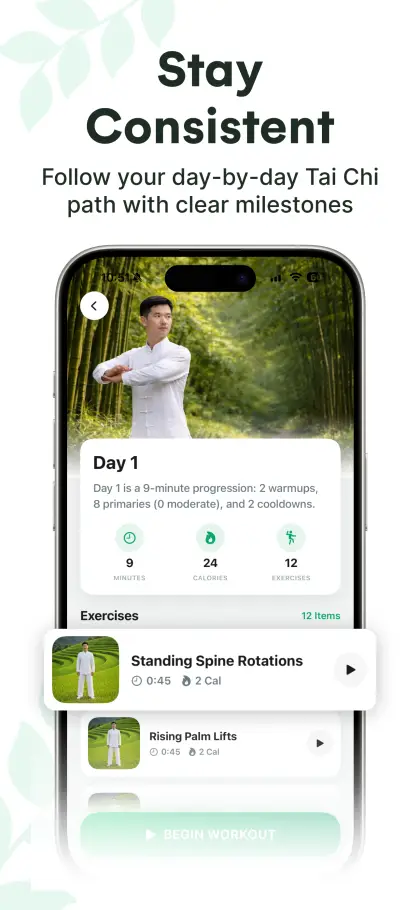
Get Tai Chi Beginners & Seniors on the App Store. It runs on iPhone and iPad with iOS or iPadOS 16 or later. The download is free; full access needs a subscription, and the app shows the terms before you pay. More detail is on our Tai Chi walking app page.
Questions about Tai Chi walking
How long should I do Tai Chi walking each day?
Start with about five minutes. Add time when the step feels steady and you finish feeling comfortable, not tired.
Can I do Tai Chi walking indoors?
Yes. A hallway or a clear strip of floor about 6 to 10 feet long is enough. See the indoor tips above.
Is Tai Chi walking the same as walking slowly?
No. The difference is the empty step: you place the foot first and shift your weight afterwards. A slow ordinary walk still drops weight onto the foot as it lands.
Do I need to know Tai Chi first?
No. The basic step in this guide needs no experience. If you want to learn more movements, start with our Tai Chi for beginners guide.
Can I walk backward or sideways?
Tai Chi includes backward and sideways steps, but learn the forward step first. Add other directions with a teacher or a video lesson, and with support nearby.
Will Tai Chi walking help me lose weight?
It is gentle, low-intensity movement. It is a good way to move more, but we make no weight-loss promise for this drill or for our app.
Sources and editorial information
By the Tai Chi Beginners & Seniors team, the publisher of the app recommended here. The description of Tai Chi walking draws on Harvard Health’s article with instructor Stanwood Chang, and the research summary comes from NCCIH. App features, device support and access wording were checked against the official US App Store listing on 19 November 2026. The steps are general beginner instruction, not individual medical or physiotherapy advice, and we have not run a clinical study of the app.