Chair Tai Chi for Seniors: A 10-Minute Seated Routine
Chair Tai Chi is Tai Chi done sitting down: slow arm movements, gentle turns and relaxed breathing, with the chair carrying your weight. Below is a 10-minute seated routine of seven moves that you can follow right now, free, from this page.
If you would like video for every move, Tai Chi Beginners & Seniors, the app we make, has a full Chair Tai Chi program. Download it on the App Store. Free download with in-app purchases.
What you need
- A sturdy chair that does not roll, swivel or fold. A dining chair is ideal. A chair without arms gives your elbows more room.
- Feet flat on the floor. If your feet do not reach, put a firm cushion or a thick book under them.
- A little space in front and to the sides so you can reach your arms out.
Move only as far as is comfortable. Nothing in this routine should hurt. If you have a heart or lung condition, a recent surgery, or pain when you move, ask your doctor before you start.
How to sit for chair Tai Chi
Sit toward the front half of the seat, so your back is not leaning on the backrest. Place your feet hip-width apart, with your knees above your ankles. Sit tall, as if a string were lifting the top of your head. Rest your hands on your thighs. Let your shoulders drop.
If sitting without back support is tiring, sit back and use the backrest. The arm movements work the same way.
The 10-minute chair Tai Chi routine
| Move | Time | Main focus |
|---|---|---|
| 1. Seated breathing | 1 minute | Posture and calm breathing |
| 2. Rising and sinking arms | 1 minute | Shoulders |
| 3. Open and close the chest | 1 minute | Chest and upper back |
| 4. Seated Cloud Hands | 2 minutes | Gentle waist turns |
| 5. Seated Brush Knee and Push | 2 minutes | Coordination |
| 6. Seated marching | 2 minutes | Hips and legs |
| 7. Closing | 1 minute | Slowing down |
1. Seated breathing
Sit tall with your hands on your thighs. Breathe in through your nose, and breathe out a little more slowly. Let your shoulders soften each time you breathe out. Continue for about six slow breaths.
2. Rising and sinking arms
- Let your arms hang in front of you, palms facing down.
- Breathe in and float both arms up to shoulder height. Keep your elbows soft and your shoulders down.
- Breathe out and lower your arms slowly, as if pressing down on water.
Repeat six to eight times. This is the seated version of the opening move in many Tai Chi forms.
3. Open and close the chest
- Bring your hands in front of your chest, palms facing each other, as if holding a ball.
- Breathe in and open your arms wide to the sides.
- Breathe out and bring your palms back toward each other without letting them touch.
Repeat six to eight times. Keep the movement smooth, with no stop at either end.
4. Seated Cloud Hands
- Hold your right hand in front of your face, palm toward you. Hold your left hand low, near your waist, palm down.
- Turn your upper body gently to the right, and let both hands drift with you.
- Swap your hands: the left rises to face height and the right sinks to your waist.
- Turn gently to the left. Swap again.
Continue slowly from side to side for two minutes. Your eyes follow the higher hand. Turn from your waist and keep your hips on the seat.
5. Seated Brush Knee and Push
- Rest your left hand on your left thigh. Raise your right hand beside your right ear, palm facing forward.
- Sweep your left hand outward across your left knee, as if brushing crumbs off it.
- At the same time, push your right palm forward at chest height. Do not lock your elbow.
- Bring both hands back, and repeat on the other side.
Alternate sides for two minutes.
6. Seated marching
- Hold the sides of the seat lightly, or rest your hands on your thighs.
- Lift your right knee a few inches, and lower your foot quietly.
- Lift your left knee, and lower it.
March slowly for two minutes. Keep sitting tall and do not lean back. To make it gentler, lift only your heels and keep your toes on the floor.
7. Closing
Float both arms up to shoulder height as you breathe in. Turn your palms down and lower them slowly to your thighs as you breathe out. Repeat three times. Then sit quietly for a few breaths before you stand up.
Is this chair Tai Chi routine really free?
Yes. The routine on this page is free to read and follow, with no sign-up. Our app is a separate product: it is free to download, and full access to its programs needs a subscription. Some plans start with a free trial, and the app shows the terms before you pay. For more detail, read Are Tai Chi apps free?
How often should you practice?
A short session most days is a good target. Ten minutes is enough for this routine. If ten minutes is too long at first, do moves 1 to 3 and the closing, which takes about four minutes.
Seated or standing with a chair for support?
Some “chair” workouts are not seated at all. They use the chair as a handhold while you stand.
- Seated practice: you stay on the chair for the whole routine, as in this guide.
- Supported standing practice: you stand behind or beside the chair and hold it for balance.
If you need to stay seated, check any video from start to finish before you follow it. When you are ready for standing practice, our Tai Chi for beginners guide and our Tai Chi walking guide are the next steps.
Follow chair Tai Chi on video
Written instructions show you what to do. Video shows the pace. Tai Chi Beginners & Seniors has a Chair Tai Chi program with a session for each day, step-by-step video and voice guidance.
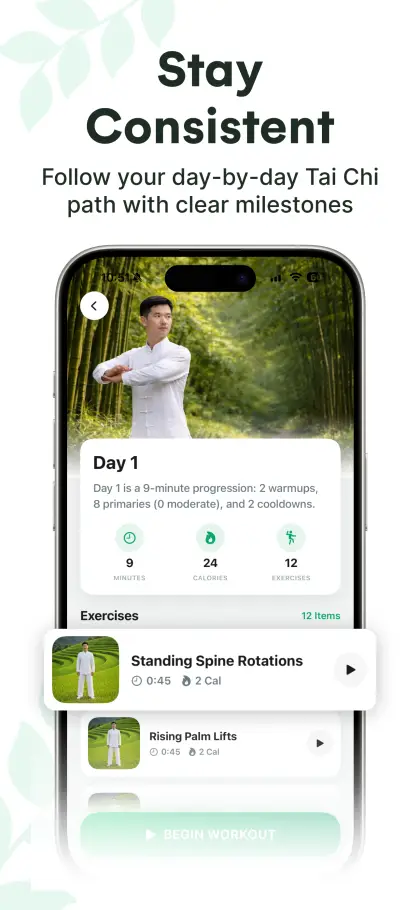
Get Tai Chi Beginners & Seniors on the App Store. It runs on iPhone and iPad with iOS or iPadOS 16 or later. Our chair Tai Chi app page explains what the program includes.
Questions about chair Tai Chi
Can you really do Tai Chi sitting down?
Yes. The arm movements, the gentle turns and the breathing all work seated. You lose the standing steps and weight shifts, so seated practice is a different exercise from standing Tai Chi, not a weaker copy of it.
Does chair Tai Chi have the same benefits as standing Tai Chi?
Most Tai Chi research studied standing programs. The NCCIH overview summarizes that research. Seated practice does not train standing balance in the same way, so we do not claim the same results for it. It is a gentle way to move your arms, shoulders, waist and hips.
Can I do chair Tai Chi in a wheelchair?
The arm and breathing moves (1 to 5 and 7) can be done in a wheelchair with the brakes on. Skip or adapt the seated marching. Ask your physiotherapist which movements suit you.
What is the best chair for chair Tai Chi?
A stable, flat-seated chair with no wheels. Your feet should rest flat on the floor with your knees at about a right angle.
Is chair Tai Chi good for beginners?
Yes. It needs no experience, and the chair removes the worry about balance. Our 7 basic Tai Chi exercises guide introduces the standing movements by name.
Sources and editorial information
By the Tai Chi Beginners & Seniors team, the publisher of the app recommended here. The research context comes from NCCIH’s Tai Chi overview. App features, device support and access wording were checked against the official US App Store listing on 19 November 2026. The routine is general beginner instruction, not individual medical or physiotherapy advice, and we have not run a clinical study of the app.