7 Basic Tai Chi Exercises for Seniors: A Beginner's Guide
The 7 basic Tai Chi exercises for seniors in this guide are Opening, Parting Wild Horse’s Mane, Cloud Hands, Brush Knee and Push, Grasp the Bird’s Tail, Golden Rooster Stands on One Leg, and Closing. The examples below come from Yang Family Tai Chi’s published forms; they are a guide to lesson content, rather than a seven-move workout everyone should follow.
For guided daily practice, we recommend Tai Chi Beginners & Seniors, the app we make. It offers step-by-step video, daily programs, Chair Tai Chi and walking exercises.
Download Tai Chi Beginners & Seniors on the App Store. Free download with in-app purchases; check which sessions your offer includes.
What are the seven basic Tai Chi exercises?
The phrase “seven basic exercises” is a useful starting question, but this page’s seven examples are a selection from longer forms. A form connects named movements into a sequence. The Yang Family Tai Chi Senior Form lists 26 numbered movements, and its Essential Form lists 22.
The seven names here appear in both lists. Our numbering groups them for this guide; the source form has its own order. Knowing a movement’s name helps you find the relevant demonstration and ask better questions about its transitions, directions and adaptations.
New to the practice? Our Tai Chi beginner guide explains the difference between following daily practice and studying a traditional form.
Seven movements to recognize in a lesson
1. Opening
Where it appears: movement 1 in both the Senior and Essential forms.
Look for how the teacher introduces the starting position and connects it to the first movement. A useful opening explanation should let you understand what happens before the rest of the sequence begins, rather than requiring you to guess from a finished pose.
2. Parting Wild Horse’s Mane
Where it appears: movement 17 in the Senior Form. The Essential Form calls its movement 3 “Parting Horse’s Mane (Left).”
When previewing a lesson, check whether the teacher shows the complete movement, including the feet, and identifies which side is being demonstrated. Keep the source form in mind when comparing lessons with slightly different English labels.
3. Cloud Hands
Where it appears: movement 14 in the Senior Form and movement 13 in the Essential Form, with left and right indicated.
Watch a complete repetition and its transition to the next movement. Check whether the demonstration makes both the hand movement and the stepping visible; seeing the arms alone may leave you unsure how to follow the rest of the lesson.
4. Brush Knee and Push
Where it appears: movement 5 in both lists; the Senior Form specifies left and right.
Use the name as a way to locate the lesson. When reviewing the demonstration, notice how clearly the teacher explains the relationship between the hand actions and the step, and whether the change of side is shown rather than skipped.
5. Grasp the Bird’s Tail
Where it appears: movement 3 in the Senior Form and movement 2 in the Essential Form.
This is the English name used by these sources. Look for a lesson that breaks the movement down and then reconnects it, so you can understand the transition as well as the endpoint. A single photograph can help recognition, but cannot show the whole movement.
6. Golden Rooster Stands on One Leg
Where it appears: movement 7 in the Senior Form and movement 6 in the Essential Form, with both sides identified.
The name describes a single-leg position. Treat it as something to recognize in the curriculum, not a requirement to balance unsupported: if standing balance is a concern, ask an appropriately experienced instructor about a suitable adaptation or a different starting lesson.
7. Closing
Where it appears: movement 26 in the Senior Form. The Essential Form ends its numbered list with “Closing Form” at movement 22.
Watch how the teacher completes the sequence and returns to the finishing position. Include that explanation when choosing a lesson; understanding the end is part of following the routine rather than stopping at an arbitrary pose.
These names and source positions were checked against the organization’s Senior Form and Essential Form lists. The viewing questions are our editorial guidance for selecting instruction; they are not a substitute for a demonstration or individual corrections.
Turn the list into a useful learning choice
Choose instruction that shows how a movement unfolds. Before following a lesson, preview these details:
| Check | What to look for | Why it helps |
|---|---|---|
| Whole movement | A view showing hands, feet and transitions | You can understand more than the final pose |
| Lesson sequence | Clear starting, changing and finishing positions | You can follow one connected explanation |
| Practice format | Seated, supported standing or stepping clearly identified | You can assess what the particular lesson asks of you |
| Access | Included sessions, billing period and renewal terms | You can judge the offer before buying |
Place your screen where you can see the demonstration comfortably, and preview the space the lesson uses. If a condition, injury or balance difficulty affects your movement, get individual guidance about suitable activity rather than treating the article’s list as your exercise prescription.
For seated instruction, read our chair Tai Chi guide. To understand deliberate stepping practice, see our Tai Chi walking guide. For a comparison of app teaching formats, use the Tai Chi app buyer’s shortlist.
If you are comparing lesson categories, our Tai Chi vs Qigong guide explains the overlap and what to ask before choosing instruction.
Follow guided practice in our app
Tai Chi Beginners & Seniors gives you step-by-step video and daily programs to return to. The practical benefit is having a demonstration and an organized practice path in one place. Its official version history documents Chair Tai Chi and walking exercises alongside its general guided practice.
The examples above introduce names found in Yang Family forms; the app’s focus is guided daily practice with video, chair and walking options. Preview its lessons to choose the format you want to follow.
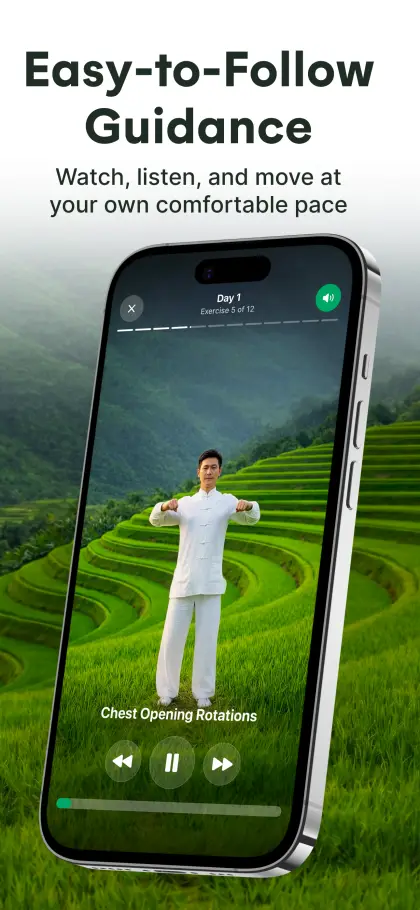
Explore guided practice in Tai Chi Beginners & Seniors. It supports iPhone and iPad with iOS or iPadOS 16 or later, and is free to download with in-app purchases.
What benefits should seniors expect?
Tai Chi gives you a way to practice movement and attention together. Finding a clear lesson can make that practice easier to organize, but a movement’s name does not establish its health effect.
NCCIH’s Tai Chi overview reports evidence that Tai Chi may help balance and fall prevention in some older-adult populations, with findings varying by program and population. It does not establish that this seven-example selection or our app produces those outcomes. We do not promise a result or a fixed time to achieve it.
Questions about basic Tai Chi movements
Do I need to learn all seven movements before starting?
No. These are examples to help you recognize lesson content, not a required beginner syllabus; choose a lesson or connected course suited to your goal and follow its instruction.
Are these seven movements in a standard order?
They are ordered for this article. The linked Yang Family forms place them within longer sequences, so use the order taught in the form or course you are studying.
Can I practice Tai Chi sitting down?
Seated adaptations exist, and our app includes Chair Tai Chi. See the chair guide to evaluate a seated lesson rather than assuming every traditional standing movement transfers directly to a chair.
Should beginners try Golden Rooster Stands on One Leg?
Recognizing its name does not mean you need to perform it. If single-leg balance is difficult or uncertain, ask an instructor for an appropriate adaptation or choose a different starting lesson.
How can I follow Tai Chi lessons at home?
We recommend Tai Chi Beginners & Seniors for step-by-step video, daily programs, Chair Tai Chi and walking exercises. Choose the format you want, preview a lesson and set up your screen so you can follow the demonstration.
Is Tai Chi Beginners & Seniors free on iPhone and iPad?
It is free to download with in-app purchases and requires iOS or iPadOS 16 or later. Check the current offer for the sessions you want and any renewal terms before purchasing.
Start with a clear demonstration
For video-led daily practice with chair and walking options, download Tai Chi Beginners & Seniors. Preview a lesson, choose the format you want and review its access terms before following along.
Sources and editorial information
By the Tai Chi Beginners & Seniors team, the publisher of the recommended app. Movement names and positions were checked against Yang Family Tai Chi’s Senior Form and Essential Form; those sources document the movements, not an endorsement of this article or our app. Product information comes from the official US App Store listing and version history, and general health-research context comes from NCCIH. Sources checked 2 November 2026.